
Early in my career, I had a humbling moment that reshaped how I think about “mastery.” A client who looked flawless in my sessions, clean data, smooth trials, consistent responding, fell apart the moment another therapist ran the same targets. Same materials. Same instructions. Same goals. Different person.
The client wasn’t demonstrating mastery. The client was demonstrating my prompts.
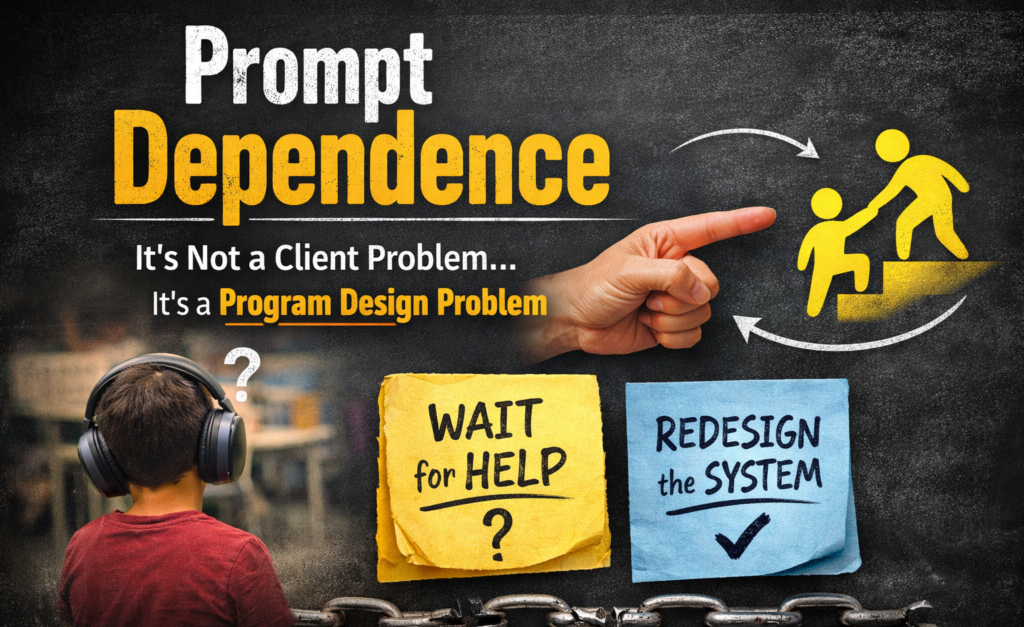
That was the moment I learned a truth many clinicians eventually face: Prompt dependence is rarely a learner deficit. It is almost always a system design issue.
Why Prompt Dependence Happens (Even in Good Programs)
Professionals often assume prompt dependence emerges from “noncompliance,” “low motivation,” or “inconsistent generalization.” In reality, the explanation is simpler and far more uncomfortable:
Clients learn the rules we teach, especially the ones we don’t realize we’re teaching.
A common pattern looks like this:

- Instruction is delivered.
- The client pauses.
- The therapist immediately gestures, models, or moves closer.
- The client responds.
- Reinforcement follows.
From the learner’s perspective, the rule becomes:
“If I wait, the clearer cue arrives and I succeed.”
This is not defiance. This is efficiency.
And when the therapist changes, the cue changes. The “real” discriminative stimulus was never the instruction; it was the prompt.
The Hidden Contingency: Prompts Work Too Well
Prompts are not the problem. Fast, automatic, predictable prompting is the problem.
When prompts occur at 0 seconds, the learner never contacts the natural cue. They never experience the contingency between the instruction and the response. They only experience the contingency between the prompt and the response.
If the prompt is the most reliable signal, it will control the behavior.
Independence Will Not Grow If It Pays the Same
One of the most overlooked contributors to prompt dependence is reinforcement structure.
If prompted responses and independent responses produce the same outcome, the learner has no reason to shift control to the natural cue.
From the learner’s perspective:
- Waiting requires less effort
- Help is predictable
- Reinforcement is identical
Under those conditions, independence is not just unlikely; it is irrational.
A more effective system makes independence clearly more valuable:
- Faster reinforcement for independent responses
- Higher‑magnitude reinforcers for independent responses
- Richer social reinforcement for independent responses
- Brief, neutral acknowledgement for prompted responses
This is not punishment. This is stimulus control transfer done correctly.
The Goal Is Not “Fewer Prompts”, It’s the Right Cue Controlling Behavior
Many teams try to “prompt less,” but reducing prompts without transferring control is a recipe for frustration.
The real question is:
Does the learner respond to the natural cue, the instruction, the visual, or the situation, without adult mediation?
If not, the issue is not the learner. The issue is the teaching sequence.
A simple starting point: Insert a 2–3 second pause before prompting.
Not a long delay that creates errors or frustration, just enough to reveal whether the learner is capable but waiting, or genuinely needs support.
This micro‑pause often exposes the truth about stimulus control.
A Practical 5‑Step Protocol You Can Use Tomorrow
- Deliver the instruction once. Then pause 2–3 seconds before providing any help.
- Reinforce independent responses immediately and generously. Make the payoff clearly better than prompted responses.
- Acknowledge prompted responses briefly and neutrally. Then move on.
- Stop repeating instructions. Repeats often become the prompt.
- Track one metric for one week: Percentage of responses occurring before the prompt. This single metric will tell you whether your system is producing independence or dependence.
Closing Reflection for Professionals
In your setting, which prompt is most likely functioning as the real cue: verbal prompts, gestures, positional prompts, or models?
And if you removed that cue tomorrow, what would the learner do?
The answer to that question reveals whether your program is building independence… or building reliance on you.